New here?
What to expect on night one.
Everything a first-timer needs to know before walking through the gate.
Your first class
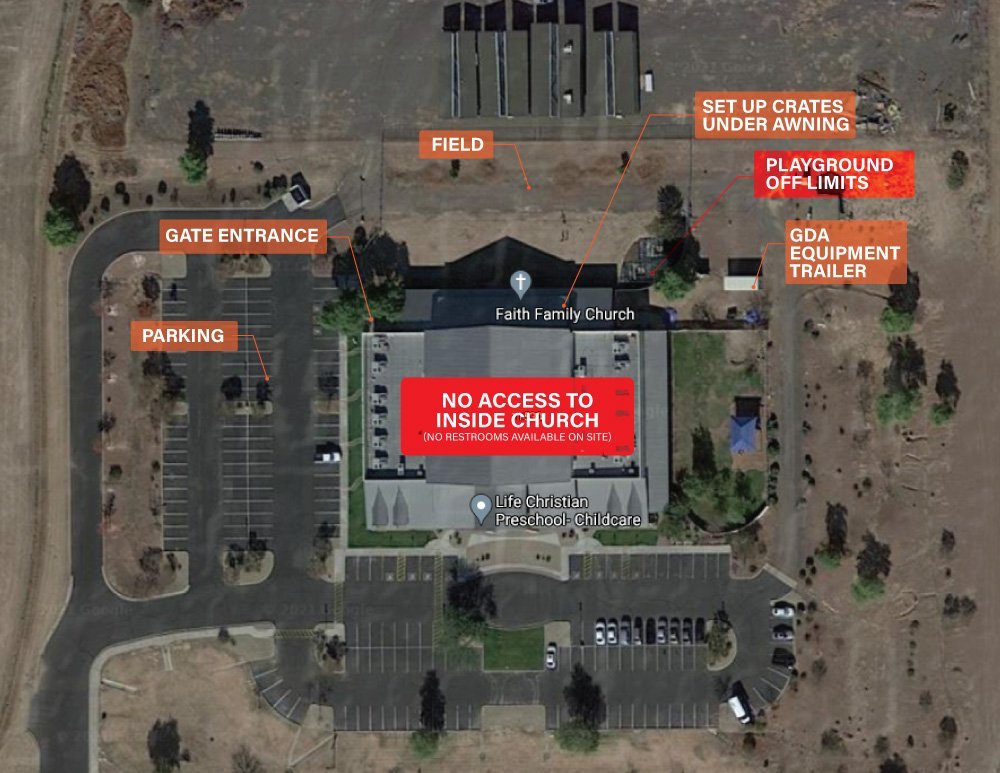
Classes are held outdoors on a fully fenced and gated training field at Faith Family Church. Expect a mix of instruction, hands-on work with your dog, and time watching other teams — watching is genuinely part of the learning, not downtime.
Arrive early enough to set up your crate before class starts. Wear shoes you can move in.
What to wear to agility class
You'll be on your feet the entire session — walking, jogging, running, and maybe even crawling through tunnels to encourage your dog. Wear clothing you can move in, and trail running shoes: the ground can be wet or uneven, so you want traction and stability on soft ground. Brooks Cascadia and Hoka Speedgoats are two we'd recommend. Bring water for both of you.
Haven't signed up yet? Our beginner dog agility class in Chandler needs no experience, or ask us about classes.
The crate requirement
A crate or pen is needed to confine your dog while equipment is being set up and during class when needed.
For the safety of your dog and others, we absolutely cannot allow a dog to be tied to a fence, chair or other object and left unattended. A tie-down stake is not sufficient, since it leaves your dog vulnerable.
Crates and pens of all types and sizes are available at pet stores, online, or by catalog. Let us know if you're having trouble locating one.
Facility rules
- Enter through the gate entrance — there is no access to the inside of the church
- No restrooms are available on site
- Set up crates under the awning
- The playground is off limits
- Park in the designated lot
- Clean up after your dog
Health requirements
Dogs must be healthy, in good physical condition, and current on vaccinations. Dogs must be at least 9 months old before the first class meeting.
If your dog is reactive
While obedience training helps, it isn't a prerequisite for our classes. Your dog should be able to cope in a large dog and handler setting without undue stress.
Please be aware that a highly reactive dog could experience more stress in a class situation, which may cause a setback in your socialization training. If you're unsure, contact us before registering — see also our aggression policy, which sets out the crate rule, the leash rule and what happens after an incident.
Missed classes
We don't offer make-up classes. If you miss a week, keep working on the homework and return the following week to work at your and your dog's pace.
What to bring to class
- Dog
- Crate or exercise pen
- Buckle collar or harness
- Leash
- Water
- Treats
- Treats bag
- Plastic tub lid, white
- Trail running shoes and clothing
- Tote bag, duffle bag or backpack
- Tug toys (optional)
- Clicker (optional)
- Red bandana (optional)
Dog
A happy, healthy and hungry dog. Because we use food as a motivator, it's to your advantage if your dog is eager to eat. If you normally feed in the evening, consider withholding that meal on class nights, or use the food motivators you'll bring to class as its evening feeding doled out in small bits. A slightly hungry dog is easier to keep engaged — and it isn't wise to ask a dog to jump or run on a full stomach.
Crate or exercise pen
Needed to confine your dog while setting up for class and during class when required. For the safety of your own dog and others, we absolutely cannot allow a dog to be tied to the fence, a chair or other obstacle and left unattended. A tie-down stake isn't sufficient — it leaves your dog vulnerable. Crates and pens of all types and sizes are available at pet stores, online, or by catalog. Let us know if you're having trouble locating one.
Buckle collar or harness
No choke, prong or shock collars are allowed. Not only do choke and prong collars pose safety hazards and risk injury, they send the wrong message. Agility training isn't about forcing dogs into a behavior, it's about learning to communicate with body language and enthusiasm. A buckle collar or chest harness is sufficient to keep your dog in your immediate control. We also recommend against halties or Gentle Leaders for agility — these pull the dog's head to the side and can be dangerous or create anxiety, because the dog can't look ahead to where it's going.
Leash
A four-foot leash is sufficient and works slightly better than a six-foot one, since there's less leash to manage. A loop at the handler end comes in handy for teamwork exercises and hands-free training. At some point you might consider a short tab leash as you start working off-leash.
Water
For you and your dog. Think of class as going to the gym — you both need to stay well hydrated. Some people also bring spray bottles or pump sprayers to wet their dogs down when it's really hot.
Treats
Bring something your dog loves — smelly and mouthwatering. Leave the dry kibble at home. Try hot dogs, cheese, liver treats or meat bits. Depending on the size of your dog, cut them into one-bite pieces: not so big the dog has to stop and chew, but large enough to be satisfying. Bring lots. Don't be stingy at this point — you can always take the extra home for homework during the week.
Treats bag
Some kind of bag you can swiftly and smoothly remove a treat from, secured to your body — a waist belt or hooked to a pocket — so your hands are free for the dog and clicker. Treat bags are available online and at Target, Petsmart and elsewhere for around $5 to $10. You can make or fashion your own, such as a fanny pack. Just make sure the opening is large enough to get your hand in and out quickly and easily, and that it holds all your treats at once.
Plastic tub lid, white
The kind used on yogurt or cottage cheese containers. We use these lids as targets, training dogs to move away from us and go to a specific place. Most of us have plenty at home. Size doesn't matter much — we eventually fade the targets away. A plain white washcloth also works.
Trail running shoes and clothing
You'll be on your feet the entire session — walking, jogging, running, and maybe even crawling through tunnels to encourage your dog. Come dressed to do so. The ground can be wet or uneven at times, so wear trail running shoes that provide traction and stability on soft ground. Brooks Cascadia and Hoka Speedgoats are two we'd recommend.
Tote bag, duffle bag or backpack
To haul all of the above.
Tug toys optional
We spend considerable time teaching dogs how to play with us. In agility, we want the dog to think that you are the most interesting thing around — not the other dogs, the equipment, or the nearest tree or shrub. The best way to play is with a tug toy. Bring at least two different ones: a ball on a string, a knotted rope. You may not need the pet store — think about what fascinates your dog: a tin pie plate, a rubber watering hose, a pine cone, an empty water bottle. If your dog likes a particular unorthodox object, bring it. Many handlers say their dogs aren't motivated, but most dogs can be taught to be toy motivated, and the tug will teach the dog to look to you for stimulus and reward.
Clicker optional
Optional as a secondary reinforcer or marker as we train. You can pick one up at Petsmart. We use a vocal “yes” as the primary marker.
Red bandana optional
If you know your dog sometimes has space issues or issues with other dogs, we ask that you indicate that by putting a red bandana on your dog. We'll let everyone know that a red bandana means to leave some extra room. Please read our aggression policy.